
Hudson Resident Lookup Record Routes
Smart Hudson resident lookup work starts with the record class, not a name alone. Summit Fiscal Public Access ties together the address, parcel, owner field, ZIP, and tax year. It puts all of that in one view. The Recorder holds a different animal entirely: the recorded-instrument trail, kept separate from assessment data. Hudson's municipal archive can tell you a document existed on a given date. It cannot tell you where that person stands today. Every record answers to a different keeper. Each keeper offers a different weight of proof for a Hudson residents directory search.
| Record class | What it can confirm | Hudson-area custodian | Access boundary |
|---|---|---|---|
| County property record | Parcel, indexed owner field, address, ZIP, and tax-year context | Summit Fiscal Public Access | Live results were unavailable during research; use the published field guide. |
| Recorded instrument | A recorded transfer, lien, lease, or other filing | Summit Recording Division | Request the actual document; an index label is not a full title conclusion. |
| Voter registration | Published registration, precinct, and polling-place result | Ohio Voter Search | Public fields are limited by Ohio law. |
| Court or probate record | A case, filing, or historic court record in the proper system | Summit Clerk selector or Probate | Coverage, sealing, and court choice affect what is visible. |
| Credential or entity filing | A published professional credential or business filing | Ohio eLicense or Secretary of State portal | Neither source proves every personal connection. |
Hold on to three things with any match. Note the date, the custodian, and the identifier. That habit pays off fast. Surnames change, streets get abbreviated, and two Hudson households can carry the same name. A dated property entry and a dated historic directory entry may both be correct. They simply answer different questions about the same person.
Confirming Hudson Resident Records
Build a short evidence trail before concluding that two records describe one person. An address helps. So does a full name paired with a known time period. The Fiscal guide lays out address number, street, parcel, owner, ZIP, and tax-year fields, while the Parcel Viewer takes a parcel number, owner name, or street address as a starting point. Treat the map as a check on geographic fit only, not as a way to read nearby parcels into a resident roster.
- Record the name spelling, address format, and the date being researched.
- Search the county property route and preserve the parcel and tax-year context returned by the official system.
- Use the Parcel Viewer to check that the street and parcel are the intended location.
- For a transfer question, obtain the recorded instrument from the Recording Division instead of treating an assessment entry as a deed.
- Compare a court, voter, archive, or vital source only within its stated record class and date range.
Leave conflicts standing rather than smoothing them over. Property systems can lag behind a recorded transfer. A voter result may carry an earlier surname or an old county address, and an older directory may preserve a spelling that has since changed. For deeper address context, the Hudson city directory collections offer dated historical material, though they are not proof of current status.
- Docket
- A court's chronological list of actions and filings in a case.
- Index and image
- An index points to a record; an image or supplied copy is the underlying document to inspect.
- Certified copy
- A copy issued by the custodian with its certification under that office's rules.
Hudson Court Records by Division
Hudson runs its court business through other courthouses. Stow Municipal Court handles the city's traffic, misdemeanor, and certain civil matters. Common Pleas cases begin at the Summit County Clerk's division selector. Probate sits apart. Federal cases belong to the Northern District of Ohio, not the county system.
| Clerk route | Published online coverage | Older-record route |
|---|---|---|
| Civil | Computerized data begins in 1990. | The Clerk says records from 2002 forward are available online immediately. Earlier records may need counter retrieval or a public-records request. |
| Criminal | Computerized data begins in 1986. | |
| Domestic | Computerized data begins in 1989. | |
| Ninth District Appeals | Index begins in 1990; full docket information begins in 1999. |
Interface dates are not proof a case began then. A no-result can mean several things. It may reflect the wrong court, an older file, a name variation, or a restriction. The Clerk's request form covers a known record with a case number, filing date, document description, up to five party names, and a certification choice.
Hudson Vital Records and Probate Dates
Match the record to the right route before you search. Vital records for a Hudson event depend on date and type. Summit County Public Health issues certified Ohio birth records. It also handles Ohio death records and county fetal-death records from December 1908 forward under its published process. Probate is the older local bridge. Its holdings include birth and death material from 1869 to 1908. Estate, guardianship, and marriage records reach back to 1840. The online marriage index starts September 9, 1980. Earlier marriages call for the Court's historic route.
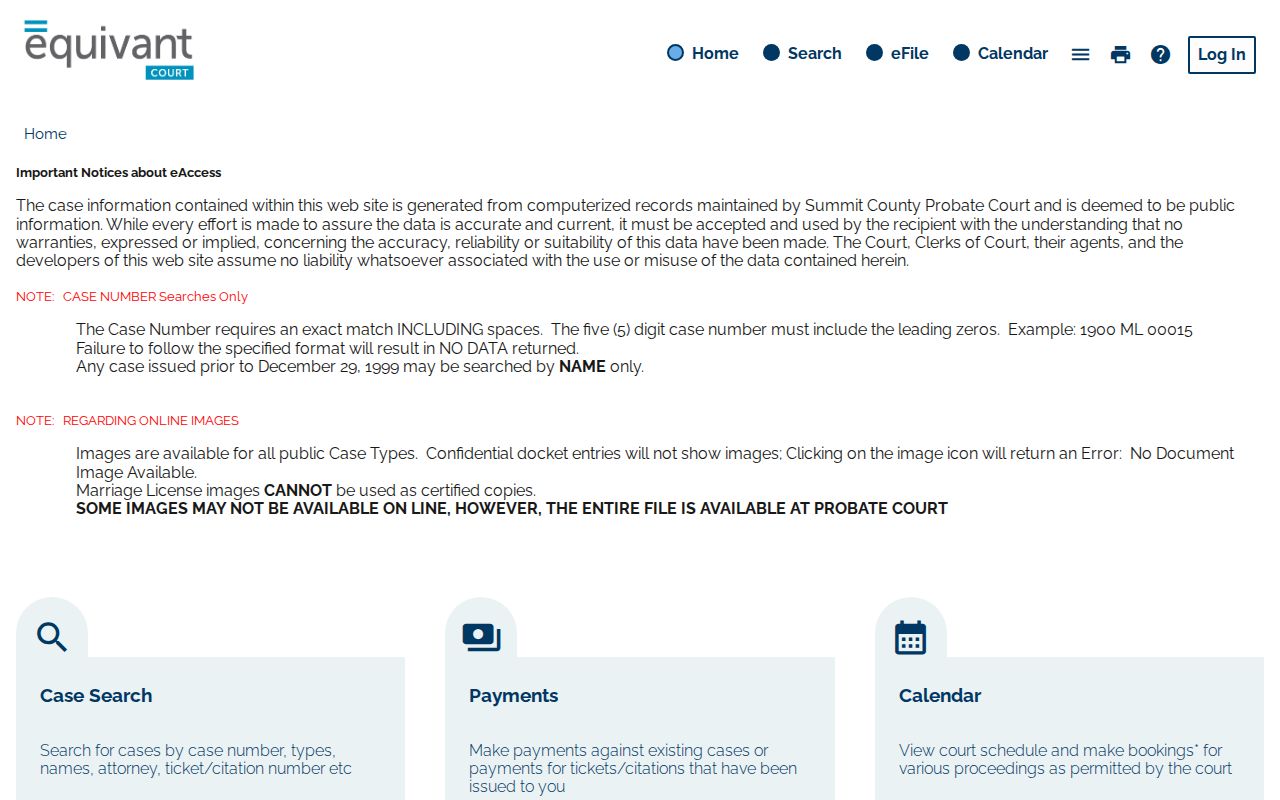
For probate work online, Summit Probate eServices is the Court's official entry point.
Certified modern copies come through Summit County Public Health. The health district publishes online, telephone, in-person, and mail channels. Its 2026 form charges $22 per certified copy. No uncertified copies are offered. A recent death certificate's Social Security information now carries added proof requirements.
Hudson Voter Lookup Fields and Limits
Ohio runs an individual Voter Search, and it is a narrow tool. It is not a full resident file. Every query asks for a first name, a last name, and a county. A Hudson voter lives under Summit in that dropdown. The state built the tool for one purpose: registration, precinct, and polling-place facts. If the search itself suggests a derivative given name, a former surname, or an old county address, those tweaks are fair game. Beyond that, a single returned record does not license a broader identity claim. It says nothing firm about who a Hudson resident is.
| Official tool | Required fields or filters | Published use and limit |
|---|---|---|
| Voter Search | First Name, Last Name, County | Registration, precinct, and polling-place utility. |
| Voter Data portal | Election, Start Date, End Date, County List, batch download | Dated snapshots; the date range is limited to seven days. |
State law keeps plenty of voter-roll detail off limits. R.C. 3503.13 bars public release of Social Security numbers, driver-license or state-ID data, phone numbers, and email addresses. Safe at Home protections, shielded addresses, and certain citizenship proofs also stay sealed. The registration form itself collects far more than any public result will show. Treat the live state result and a dated snapshot as two different products. Each has its own limits.
Hudson Credential Lookup Limits
Ohio eLicense is the state's official route for verifying a professional credential. The detail page can show status, substatus, board or category, and the credential number. Issue, effective, and expiration dates may appear too. Public location, endorsements, and board actions show up when they apply. Filters vary from board to board. Use the live eLicense search rather than assuming a fixed set of controls.
The Secretary of State's business portal has its own boundaries. It documents an entity name, a filing, a statutory agent, or a status trail. It does not maintain a general list of owners or officers. So a filing never proves control. A home address is not proven either. Nor is any relationship the record does not state. UCC filings are separate. They track secured transactions, not parcel title or personal history.
Hudson Resident Lookup Evidence Grades
Matching names are not equal evidence. Grade each result and the picture stays honest. An archive lead, a map label, or an uncorroborated transcription should never harden into a settled identity claim. The Hudson residents directory workflow keeps conflicts visible and reaches for the original record whenever one exists.
| Evidence grade | Hudson example | How to use it |
|---|---|---|
| Direct custodian record | Recorded instrument image, Clerk-certified copy, property card, or official voter result | Keep source and date, using only necessary factual fields. |
| Official index or map | Parcel Viewer, Ohio History death index, or City archive result | Use as a lead or location aid; open the underlying record when offered. |
| Institutional finding aid | Hudson house guide or directory guide | Describe its collection scope and follow the cited primary source. |
| Uncertain lead | OCR text or a mismatched spelling | Leave unresolved until another source supports it. |
Keep the custodian and the observation date beside every fact. That habit pays off. It lets you ask the right office about a conflict instead of forcing records from different systems to agree.
Hudson Privacy and Sealed Records
Ohio's public-records baseline, R.C. 149.43, opens nonexempt parts of an existing public record to any requester. An office must mark what it redacts. The statute never forces a records office to build a new compilation. Nor must it hand over protected fields. Driver and motor-vehicle personal information stays confidential under R.C. 4501.27, and recent vital records carry their own sensitive-field limits.
Safe at Home supplies eligible survivors with a substitute address in certain public settings. So a missing or alternate address is a safeguard. It is not a puzzle to rebuild from neighboring records. Per the Clerk's description, sealed records leave public access entirely. Expunged records are destroyed or deleted. The Recording Division likewise keeps military-discharge documents closed to the public.
Lawful use. Use Hudson records for personal, lawful research and keep protected information protected. Do not use a resident lookup to stalk, harass, or intimidate anyone.
Hudson Record Search Scam Checks
Before paying for any court, land, vital, or business record, start at the custodian's official domain. Compare the charge against the posted form or fee schedule. The Summit County Clerk has warned about a fraudulent website impersonating the Clerk. Use the Clerk's official selector. Avoid links from unsolicited messages. Avoid look-alike advertisements too.
The Secretary of State warns about misleading mail. Email, text, and phone offers can mimic official notices. Business Services email addresses end in @ohiosos.gov. The office says it never sends text alerts to those customers. Check the domain on your own. Check the office phone number too. Do this before sending payment, ID, or a document.
Hudson Records Request Fallback
When an online route misses the date or record you need, ask the keeper directly. Request a known existing record. The Summit Clerk's public-records form works in person, by mail, fax, or electronic submission. Pickup or mail delivery is available. Published fees include $0.10 per ordinary page and $1 per certified page. A computerized docket page also costs $0.10. Authentication costs $5, and special reports run $25 per 15 minutes.
Name what you already know. List the case number, filing date, document description, party name, or certification need. Hudson City's public-records route covers City-held material only. County deeds, taxes, marriage, birth, death, and court files live elsewhere. A focused request is easier for an office to locate. It also respects the line between an existing document and a new compilation.